Year-end closing: the essential checklist for accountants in Europe

Coordinating group and local company reporting can make year-end closing a complex process. This guide provides practical steps to enhance efficiency and ensure a timely, accurate financial close.
With year-end closing activities approaching, companies across Europe should review their upcoming group and local accounting reporting requirements. By performing these essential baseline checks, your accounting teams can align processes and reduce complexity during this critical quarter.
To help you achieve a smooth year-end close, we’ve compiled a practical checklist of essential tasks for accurate and compliant financial reporting.
1. Review 2025 financial statement filing deadlines
Start by mapping out all relevant filing deadlines for both group and local reporting. Deadlines for group reporting are usually much tighter than those for local financial statements. For example, in Germany, which ranks 21st in the world for financial compliance complexity, local financial statements must be prepared and filed by 31 December of the following year. In Belgium, the deadline for 2025 financial statements is 31 July 2026. Most countries give accountants more time to prepare and close local accounts, but group reporting deadlines remain strict.
This difference impacts the year-end financial closing calendar and how post-balance sheet events are reflected in financial statements. Check all relevant filing deadlines before starting any closing procedures.
2. Understand statutory audit consolidation thresholds
Statutory audit requirements and consolidation thresholds vary by country and are frequently updated. In most EU countries, a statutory audit is required if a company exceeds certain thresholds for turnover, assets or number of employees. For example, Germany requires an audit if two of three thresholds are exceeded: €6m turnover, €3m assets or 50 employees. Belgium requires an audit for companies exceeding €9m turnover, €4.5m assets or 50 employees. Companies must comply with threshold levels in each country where they operate.
3. Track changes in IFRS vs local GAAP formats
Accounting standards continue to evolve, requiring companies to stay vigilant and adapt their reporting practices accordingly. Netherlands, Italy and Portugal do not require cash flow statements for local GAAP. Germany and France require cash flow statements for consolidated accounts and International Financial Reporting Standards (IFRS) filers. Some countries require statements of comprehensive income, while others do not. France, Germany, Norway, Portugal and Poland do not require a statement of other comprehensive income. Stay updated on any legislative changes and amendments to accounting forms, formats and filing steps since your last year-end close.
4. Align group vs local accounting treatments
Review these key areas:
- Estimates: pension costs, bonuses and holiday accruals may differ at group and local levels
- Provisions and contingencies: Netherlands allows provisions even if an obligation may not exist. Germany and Italy allow provisions for all risks
- Adjusting events: Germany requires strict knowledge at the balance sheet date for adjustments. In the Netherlands, profit distributions and post-year-end dividends are included in current liabilities
- Revaluation options: available in Netherlands, Romania, Portugal and Poland. Collect the right information to identify the correct accounting treatment for each jurisdiction
5. Coordinate with legal teams
Capture year-end corporate secretarial requirements in your financial close calendar and coordinate with legal teams to avoid missing steps and incurring penalties.
6. Embrace digital transformation
Leverage ERP systems, automation tools and cloud-based accounting platforms to streamline processes, reduce manual errors and improve compliance. Digital solutions help manage deadlines, track regulatory changes and facilitate collaboration across borders.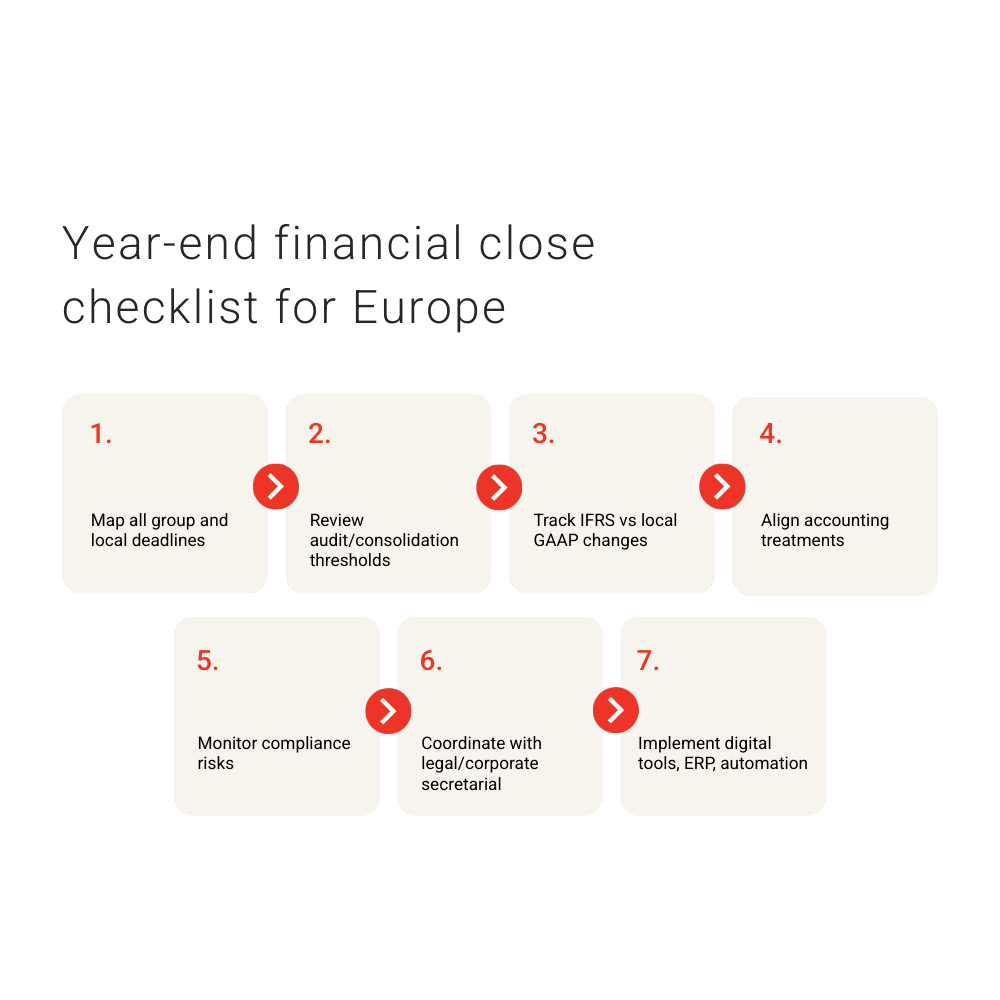
Compliance pitfalls to avoid
Here are some of the key compliance areas finance teams need to consider during the year-end process:
- Misalignment between group and local reporting deadlines
- Complexity of statutory audit and consolidation thresholds across countries
- Differences in accounting treatments (provisions, revaluation, post-balance sheet events)
- Legal and corporate secretarial dependencies often overlooked
- Risk of penalties due to missed filing steps or outdated formats
For European finance teams, year-end closing brings unique challenges, including multiple reporting standards, group coordination and tight deadlines. Yet with the right structure, tools and communication, those challenges become opportunities for growth. A well-executed close doesn’t just finalise the year; it strengthens accuracy, builds trust and sets the stage for a more efficient financial future.
Key takeaways
- Group reporting deadlines are stricter than local deadlines and vary by country
- Audit and consolidation thresholds differ across EU jurisdictions
- IFRS and local GAAP formats each have distinct requirements for the format and content of financial statements
- Accounting treatments for estimates, provisions and events vary by country
- Legal coordination is essential to avoid delays and penalties
- Digital tools improve accuracy, compliance and cross-border collaboration
- Watch for misaligned deadlines, audit complexity and overlooked legal steps
- A well-structured close builds trust and sets the stage for future efficiency
Talk to us
Located in Europe’s key markets, our team of accounting and tax specialists can help your company navigate local regulations for a seamless group financial close. Contact us for tailored financial reporting support, wherever you operate in Europe.
Download our latest Global Business Complexity Index (GBCI) report now for actionable accounting and tax insights to power your expansion journey.